The Time Traveler’s Pen Pal
Romance · Published
The pen was in a box of odds and ends at an estate sale in Savannah, between a tarnished thimble and a bundle of buttons. It was a slim fountain pen, black enamel gone soft at the edges, with a gold nib worn to a gentle slant by some long-dead hand. Josephine Hart paid two dollars for it and thought no more about it than that.
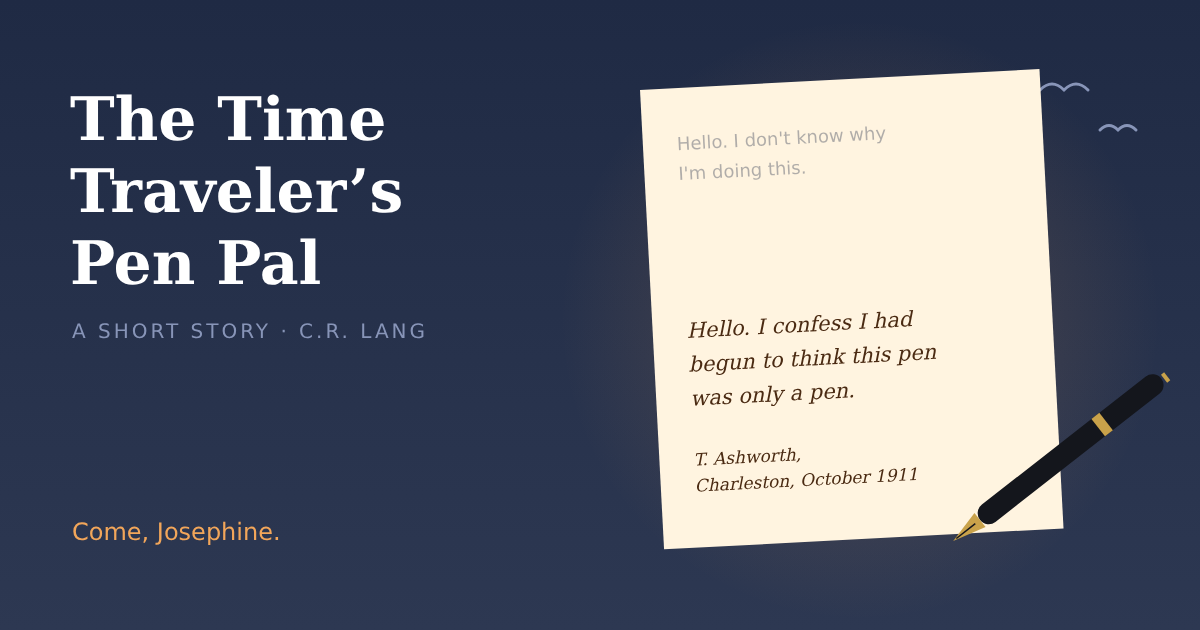
She was thirty-four, a restoration archivist who spent her days repairing other people’s paper and her evenings alone in a rented apartment that smelled of old books. That night, on a whim, she filled the pen from a bottle of walnut ink and wrote on the back of a cataloguing slip: Hello. I don’t know why I’m doing this.
The ink sank into the paper as if it were drinking. She watched the words fade until the page was blank.
Then, slowly, from the bottom edge upward, a line of handwriting bloomed in a stranger’s slanting script.
Hello. I confess I had begun to think this pen was only a pen. With whom do I have the honor? —T. Ashworth, Charleston, October 1911.
She did not sleep. She sat at the kitchen table until three in the morning, writing and watching her words vanish and his arrive, and by dawn she had accepted the impossible the way a tired person accepts anything, all at once, with a kind of dazed gratitude.
Thomas Ashworth was twenty-nine and kept the ledgers for a shipping firm on East Bay Street. He lived in a boarding house with a landlady who disapproved of his candles. He wrote in a careful, courteous hand, and he asked questions as if each one mattered.
You say it is 2024 where you are, he wrote on the third night. Tell me something ordinary. Not the wonders. I should like to know what a morning is like.
So she told him. The hiss of the coffee maker, the glow of her phone, the hum of a refrigerator that kept food cold without ice. He answered with the clatter of the iceman’s cart, the smell of coal smoke, and the gulls on the harbor wall that woke him before the bell. They traded mornings across a hundred and thirteen years like children passing notes under a desk.
It was a slow thing, the way it deepened. She would later try to find the moment and fail.
He told her he wanted to be a poet and had never shown anyone a line. She told him she had once wanted to be a painter, and had quietly stopped after a teacher called her work competent. He wrote back, at once and with unusual heat: Competent is the word people use for what they cannot bear to praise. Send me what you have made. I will tell you the truth.
She sent him a description of a small watercolor, a window with rain on the glass. He wrote three pages in reply. She read them standing up in her kitchen, with her hand over her mouth.
He told her his fears in the small hours, when the pen seemed to carry his voice more truthfully. That he would spend his life tallying other men’s cargo. That his mother’s cough had returned and the doctor would not meet his eyes. That he sometimes walked to the end of the wharf at night and stood watching the dark water, not from despair, but from a vague, aching sense that his life was happening somewhere he could not quite reach.
I think, he wrote, that I have been waiting for something without knowing its name. And lately I think the name is your handwriting.
She put down the pen. She walked once around her apartment. Then she picked it up again and wrote the truest thing she had ever put on paper: I have been waiting too.
In January, she looked him up.
She told herself it was research, as an archivist might. She found him in a digitized city directory, then in a census record, then, with a sinking in her stomach, in the register of the Magnolia Cemetery.
Thomas Ashworth. b. 1882. d. March 1912.
She read the date until the numbers swam. Five months from the first letter she had received. Five months of mornings and ledgers and wharf-side evenings left to the man whose handwriting she knew better than her own.
She did not tell him. For a week she wrote of trivial things, the weather, a book, her cat, and she felt each lie of omission land on the page like a stone. But he was not a fool, and he knew her by now.
Josephine, he wrote. You have grown careful with me. Whatever it is, I would rather have it plain.
She told him. She wrote it all out in a long, shaking hand, the cemetery, the date, the register, and sent it across the century, and then she sat in the dark and waited for the ink to answer.
It was a long time coming.
Well, he wrote at last. I confess I had hoped for more than five months. But I find I am less afraid than I should be. I have had more in these three months than in the twenty-nine years before them.
And then, beneath it, in a hand that was no longer steady:
Is there a way for you to come to me? I do not ask lightly. I do not know what the pen is, or what it permits. But I have been turning it over. If words can cross, perhaps more can.
She spent the night with the thought.
She was not reckless. She had built a life out of careful, preserving things. She had a job she was good at, a mother in Ohio, a world that made sense in the ordinary ways. And what he was asking, what she was beginning to ask herself, was to walk away from every bit of it, into a year without penicillin, without anyone she had ever met, into a city that would not know her name. To love a man with five months left on the clock. To lose him anyway, in a place where she would have no one to hold her when it happened.
She knew what she would say if a friend asked her. She would say it was madness.
But she thought about the wharf, and the dark water, and a man standing at the edge of it, waiting for something he could not name. And she thought about the long beige years of her own life, the quiet, competent, cataloged years, and how the only time she had felt entirely, painfully alive was in a kitchen at three in the morning, watching a stranger’s handwriting rise from the page like a held breath.
She wrote one question. If I come, and I cannot get back, do you still want me to?
The answer came at once, without hesitation, in a hand she would have known anywhere.
I would rather have you for a day, knowing the day would end, than have the years without ever having heard your voice. Come, Josephine. Or do not, and I will love you either way. But I should like very much to meet the woman who taught me what I was waiting for.
She set down the pen and looked around her small, tidy apartment. At the shelves of books, the stack of unpaid bills, the cat asleep on the radiator. At the watercolor she had finally, last week, started to paint again, a window with rain on the glass.
She picked up the brush, and under the window, in a small, crooked hand, she signed her name.
Then she picked up the pen. She did not know what would happen when she touched the nib to the page and wrote the words I’m coming. She knew only that it was the first thing she had ever wanted that was not careful, and that somewhere, a hundred and thirteen years away, a man was standing at a window in the October light, watching the gulls over the harbor, and waiting for her handwriting to arrive.
She wrote the words. The ink sank into the paper like a breath.
And the room, quietly, began to turn toward morning.