The Language of Flowers
Romance · Published
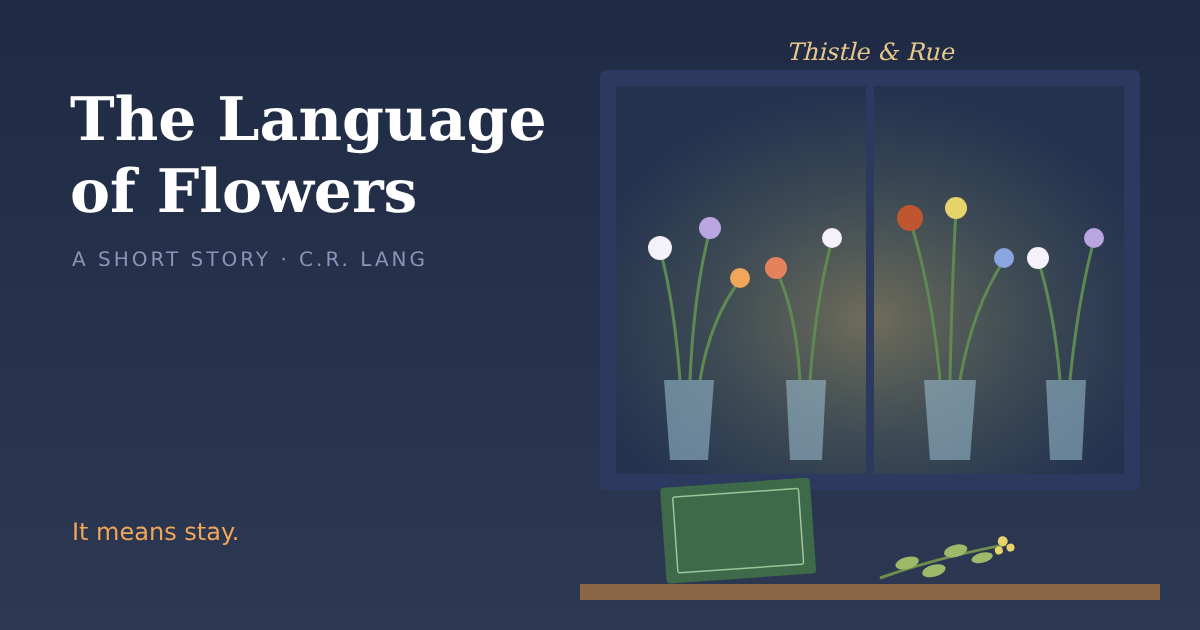
Odalys Brandt had run Thistle & Rue for eleven years, and in that time she had learned that most people did not know what they were saying when they bought flowers.
They said it anyway. A man in a hurry would grab red roses for an anniversary, unaware that, in the old language, a full-blown rose past its peak meant love already fading. A woman buying yellow carnations for a coworker was announcing, to anyone who could read it, that she was disappointed in her. Odalys never corrected them. It would have felt like reading a stranger’s mail aloud. She simply tucked a sprig of something kinder into the paper when she could, a little rosemary for remembrance, a little myrtle for good will, and let the bouquet say what the customer had meant to say.
She kept the dictionary in her head and in a battered green notebook behind the counter, where she had spent a decade adding to the Victorian tradition. Her own entries, in pencil: Dried lavender, for the grief that has softened. Snowdrop and ivy, for the first brave day after a loss. Marigold, but only the late ones, for forgiving oneself.
She had never expected anyone to answer her in kind.
The first order came in on a gray Tuesday in March, by email, from a name she did not know. Mr. A. Finch. Delivery to the shop itself, to be collected by me at the end of each week. I leave the arrangement to your judgment, with the following exceptions.
The exceptions were a list. Three stems of white hyacinth. One branch of flowering quince. A single sprig of sage, if you have it.
Odalys read it over the rim of her coffee and felt her pulse quicken, because she knew what it said. White hyacinth: loveliness, and a request for prayer on one’s behalf. Flowering quince: temptation, or the first stir of ambition. Sage: esteem, and domestic virtue, but also, in older sources, wisdom that comes dearly.
It could have been chance. Most people had no idea. But the combination was so deliberate, so quietly composed, that she could not make herself believe it. She wrapped the arrangement that Friday with extra care, and slid in a stem of her own, a single sprig of forget-me-not, to see what would happen.
Mr. Finch collected it at closing time. She was in the back room, watering ferns, and by the time she came out, the bell above the door was still swinging and the bouquet was gone. On the counter lay an envelope with a pressed flower inside, a small blue violet, and nothing else.
Violet, she thought, with a strange, bright drop in her stomach. Faithfulness. Modesty. I have noticed you.
It went on for weeks. She never saw him, only his handwriting and his flowers, and by April she had stopped pretending it was a coincidence.
Each Monday, an email arrived with the week’s list, and each list was a sentence. Tuberose, one stem. Wild strawberry blossom. Two white lilacs. She decoded them at night with the green notebook open on her kitchen table, a pencil between her teeth. Dangerous pleasures. Perfect goodness. The first emotions of love. She would sit and stare at the words, aware of the tick of the clock, the hush of the street outside, and the odd sensation of being addressed by someone who understood the grammar.
She answered in the only way she could. She arranged each bouquet to reply. When he sent a cluster of striped carnations, which meant refusal, I cannot be with you, she set it in a vase beside a branch of apple blossom, preference, and a single orange lily, I will not give up. When he sent daffodils, regard, she returned with a spray of honeysuckle, devoted affection, and tucked a stem of columbine into the center, which had once meant I am a fool for you, and which she had never before dared to use.
For a week she heard nothing, and she wondered if she had gone too far.
Then, on a Thursday, a hand-delivered envelope arrived at the counter. Inside, wrapped in tissue, was a single stem she did not recognize. She had to look it up. It was a clover, but a rare one, a four-leaved sport from the hedgerows of some northern county, and the card beneath it said, in a tidy slanted hand: The old books say it means “be mine.” I think it also means “I’m afraid.”
Odalys sat down on the shop floor, among the buckets and the green smell of cut stems, and laughed until she cried.
She wanted to find him. Of course she did. She grew fierce about it, in the way of a person who has been quietly in love with a rumor for two months. She went through the order records. She found the email address, which led nowhere, and the card on file, which belonged to a business account with a bland name, and she stood at the counter on a Saturday night with her fingers on the keyboard and thought: I could trace this. I could know.
But she did not. She closed the laptop. There was something about the language that forbade it. The Victorians had used it because certain things could not be said aloud, and she thought that if she broke the code by force, she would be doing exactly the thing she had refused to do to every customer who walked into her shop. She would be reading someone’s mail.
So she wrote him an answer instead, in the only form she trusted.
She spent the whole night on it. She chose each stem with the slow care of a woman composing a poem. Lily of the valley, the return of happiness. A single red tulip, a declaration. Moss, maternal love, but also, in some sources, charity, which she meant as please be patient with me. At the center, in a small paper cone, a sprig of rue, the flower for which the shop was named, which meant regret, and also grace, and which in her own private grammar meant I have been alone for a long time and I am not sure I remember how to stop.
She left it on the counter with a note: For Mr. Finch. Collect at your leisure. I will be here, in the back, with the ferns.
He came on a Friday at closing time, as he always did. She heard the bell, and then, for the first time, she heard his footsteps, slow, uncertain, a man stopping at every second step to decide whether to turn back.
She did not go out. She stood in the back room with a watering can in her hands and her heart in her mouth.
“Ms. Brandt,” said a voice at the doorway. It was quiet, a little hoarse, the voice of someone who had rehearsed this and lost every word. “I’m not very good at this. I’ve been practicing for two months and I think I’ve forgotten the grammar.”
She turned. He was tall and slightly stooped, with ink on his cuff and the bouquet in his hands, already a little crushed where he had been gripping it. He had a face she had never seen, and she knew it at once.
“Aldous Finch,” he said. “I work in the botanical archive across the river. I have never bought a flower in my life before March. I only knew them from the books, the old herbals. I’ve spent twenty years reading the language and no one to say it to. And then I walked past your window in February, and there was a bunch of dried lavender and snowdrops in the glass, and I thought: there is someone who is saying something, and she means it.”
Odalys put the watering can down. Her hands were shaking.
“That was for a customer’s mother,” she said. “She had passed.”
“I know. I could read it.” He took a step closer. “I could read all of it. That’s the trouble. I’ve been reading you for months, and I think I’m in love with someone I’ve never spoken to, and I don’t know the words for that. Only the flowers.”
She crossed the room. She took from the bouquet in his hands a single sprig, the rue, and placed it, very gently, behind his ear, where a man might tuck a pencil.
“There’s a word for it,” she said. “It’s not in the dictionary yet. I’ve been adding to it.”
“What does it mean?”
“It means stay,” said Odalys, “and it grows wherever you plant it.”
In the front window, the evening light fell through a hundred glass vases, and the whole shop glowed green and gold, and neither of them said another word for a very long time. They did not need to. The flowers, as ever, had said it first.