The Memory Matchmaker
Romance · Published
Wren Ashby worked the counter at a memory exchange on Calloway Street, where people sold their worst days for rent money and bought other people’s best ones for a little color. She was good at the job because she was careful. She never sampled the stock, never kept a vial past closing, and never let herself want what passed through her hands.
Then a courier mislabeled a shipment, and she swallowed someone else’s life by mistake.
It was an honest error. The vial sat in the cooler beside her own, the same pale blue, and the tag had smudged in the condensation. She had been tired, and the dose was meant to be hers, a small tonic of her grandmother’s kitchen that she took on her worst evenings. She drank it standing at the sink, closed her eyes, and waited for the smell of cardamom and warm bread.
Instead she was standing on a pier at dawn, and the cold was in her teeth, and she was nine years old and crying because her father’s boat had not come back yet.
She was not Wren. She was a boy named Callum, and she knew it the way you know your own name.
The memories came in layers over the following days, surfacing like objects in a thaw. A kitchen with yellow curtains. The ache of a broken wrist. A dog named Biscuit who had died in the spring. A girl at a bus stop, rain on her glasses, laughing at something he had said, and the dizzy, private certainty that he would remember this forever.
Wren did not recognize the girl. She watched the memory three times before she understood why it hurt.
The girl had her laugh.
It was not her face. The girl in the memory had dark hair and a gap in her teeth. But the laugh, that sudden, helpless bark that Wren had spent her whole life embarrassed by, was hers exactly. And in the memory, the boy who loved it stood in the rain with his heart wide open, as though he had been waiting his whole life to hear it.
She found more. A thousand small proofs, scattered through his days like stones across a river. He hummed the same three notes she hummed when she was nervous. He alphabetized his spice rack, and so did she. He had once walked four miles in the dark to return a stranger’s lost glove, and she had done almost the same thing, in a different city, a different year. They had stood in the same rooms at different times. They had read the same books in the same order. They had been shaped, she began to understand, by the same hollow, and had grown toward each other without ever meeting.
It had a name, in the trade. The brokers called it resonance, and said it was a myth, a sales pitch whispered over expensive vintages. A mind that fit another so well that their memories could be swapped without rejection, like keys cut from one blank.
There was a rarer word, which the old brokers used and the young ones laughed at. Soulmate.
She spent three nights with the memories before she did the responsible thing, which was to check the shipping ledger.
The courier’s records led to a donor registry, and the registry to a name. Callum Reyes. Thirty-one. A sound technician who had sold a block of childhood memories eight months ago to cover his mother’s medical bills. The buyer’s name was redacted, as it always was.
Wren stared at the screen until the numbers blurred. There was a rule, written in the exchange’s founding charter, about memories that ended up in the wrong mind. They had to be returned. The donor had a right to his own life, and the law was clear, and the extraction was simple enough, a small procedure, ten minutes in a reclined chair.
But returning them meant forgetting. She would lose the pier and the yellow curtains and Biscuit. She would lose the girl with her laugh, and the feeling of being loved with such uncomplicated devotion by someone she had never met. It would be like waking from the best dream of her life and watching the details dissolve.
Or she could find him.
She turned the thought over like a coin. She did not know him. He did not know her. For all she could tell, a man might share your memories and still be a stranger, a person who snored and held grudges and forgot birthdays. The boy on the pier was not the man at the other end of the city. She had loved the idea of him, borrowed in secondhand pieces, and that was not the same as love.
But there was one memory she kept returning to, which she had found on the fourth night, tucked behind the others.
It was recent. Callum, grown, sat alone in a clinic waiting room with the paperwork for the sale in his hands. He was reading the line that said irrevocable. He thought, with perfect clarity: Whoever gets these, I hope they take better care of them than I did. I hope they’re happy.
He had sold his childhood and wished its stranger well.
Wren put her face in her hands, and for the first time in years, she cried without being sad.
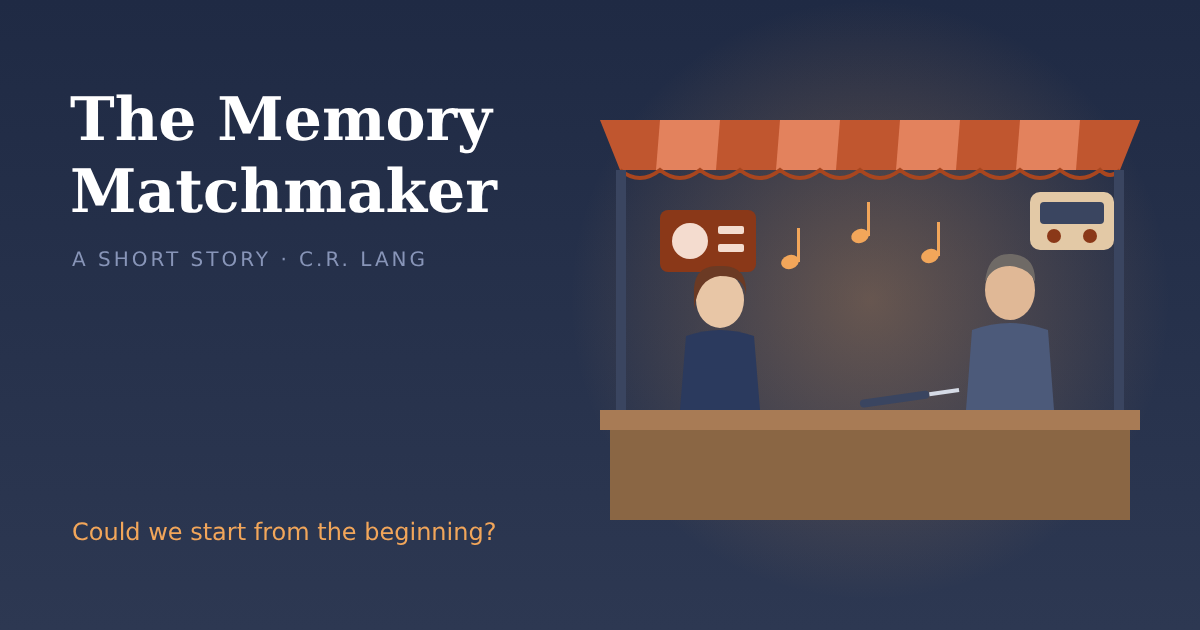
She found him on a Sunday, at a repair stall in the Fenwick market, bent over a dismantled radio with a soldering iron in his hand. He was taller than the boy in the memories, and his hair was streaked with early gray. He did not look up when she approached.
“Callum,” she said.
He glanced up with polite, tired curiosity. And she watched his face fail to recognize her, and watched her own heart do something stubborn and foolish in response.
“I think,” she said, “that I have something of yours.”
She had rehearsed it for two days. She had planned to be calm, to explain the mix-up, to offer the return and walk away clean. But when she tried to speak, what came out was the first thing that rose in her.
“Biscuit,” she said. “He liked to sleep on your feet. You were nine when you got him, and the pier, you waited for your father’s boat. He came home. He always came home, in the end, but that morning you didn’t know.”
The soldering iron dropped from his hand and rolled across the table, and neither of them moved to catch it.
“Nobody knows that,” he said, very quietly. “I sold it. It’s gone.”
“It isn’t,” said Wren. “It was in a vial that ended up in me. I should give it back. The law says I have to.” Her voice cracked. “But I’ve lived in it for a week, and I know it’s selfish, and I’m asking anyway. Could we start from the beginning? Not with the memories. With us.”
He looked at her for a long, searching moment. Then, at the corner of his mouth, something began to happen that she recognized, because she had watched it from the inside of his head, in the rain, at a bus stop, a long time ago.
He was trying not to smile and failing.
“What’s your name?” he asked.
“Wren.”
“Wren,” he repeated, as though testing it against something. Then he laughed, a short, surprised breath of a laugh, and it was not hers, but it rhymed with it. “I used to hum a song when I was nervous. Three notes. Do you know it?”
She did. She hummed it back.
And in the noise and the afternoon light of the Fenwick market, among the radios and the borrowed lives, two strangers stood together and began to make a memory that belonged to no one but them.