The Heart’s Algorithm
Romance · Published
In the city of Veridian, nobody fell in love by accident anymore.
On their twenty-second birthdays, every citizen received a letter from the Concordance, the municipal matching system that had spent forty years refining its predictions. The letter contained a name, a photograph, and a compatibility score. The scores were never lower than ninety-four percent. The Concordance had been wrong, by its own published figures, only eleven times in a generation, and each error had been followed by a public apology and a gentle adjustment of the model.
Imogen Vale had received her letter three years ago and had burned it in the sink.
She was a systems auditor by trade, which made her rebellion irritating to everyone who knew her. She understood exactly how the Concordance worked. It harvested sleep patterns, purchase histories, voice stress, and a thousand other signals, then smoothed them into a portrait of the ideal partner, someone whose habits would never rub against yours. Its matches were calm and kind, and the couples were happy in the way a well-tuned engine is happy.
What bothered her was the smoothing. The Concordance discarded outliers. It treated the strange parts of a person, the superstitions, the irrational loves, the unreasonable fears, as noise to be filtered. Imogen had a great deal of noise. She talked to herself while cooking. She couldn’t pass a stray cat without stopping. She kept every ticket stub she had ever been handed, in shoeboxes, in no order, because throwing them away felt like betrayal. She had a temper that arrived fast and left slowly, and she hated being managed.
None of that appeared in her Concordance profile. She had checked.
So one winter night, after a third glass of wine and a fight with her sister about whether she was being difficult, Imogen opened a blank terminal and began to write her own.
She called it Flaw.
It took her four months. She fed it nothing the Concordance would have wanted. Instead she wrote out, by hand, a catalog of her own defects, as honest as she could make it. Interrupts when excited. Sulks after losing arguments. Cannot admit she is lost. Cries at commercials, denies it. Keeps score, privately, of every kindness she has done. Then she wrote what she needed, which was harder, because it was less flattering. Someone who argues back. Someone who isn’t afraid of her. Someone who finds the mess interesting rather than something to fix.
She built the model to look for friction, not harmony, for the specific kinds of difference that sharpened rather than dulled. She scraped public records, forum posts, and open archives, anywhere people had left their unfiltered selves lying around. She let it run for eleven days.
On the twelfth, it returned a single name and a score.
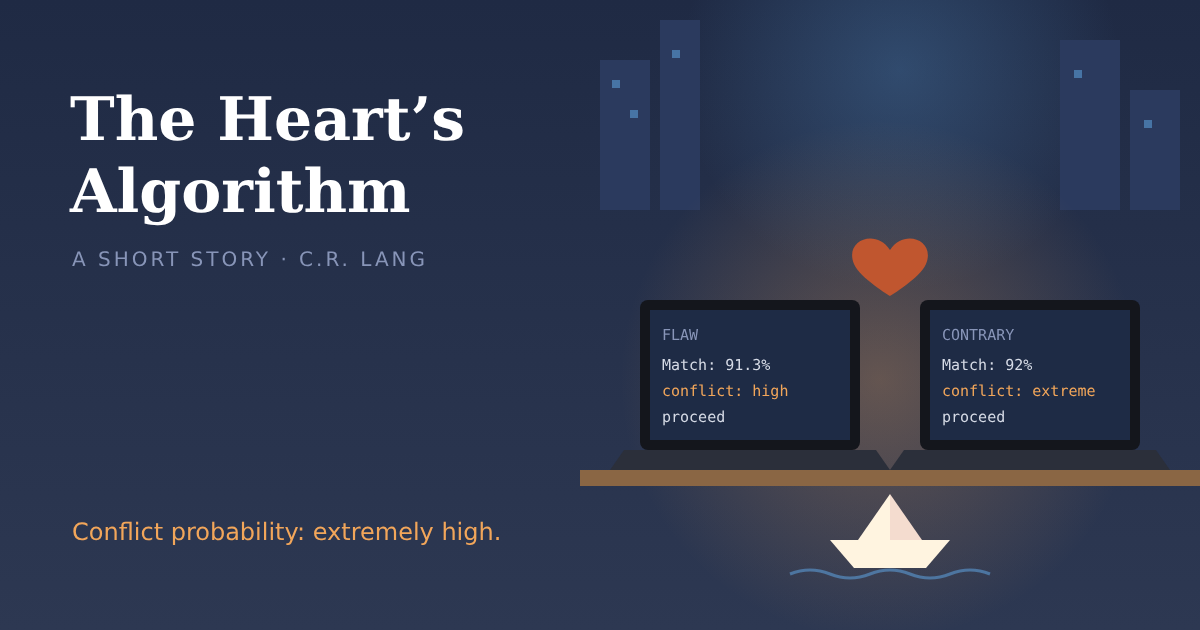
Match: 91.3%. Note: high conflict probability. Recommended: proceed.
The name was Callum Reeve.
Imogen stared at the screen. Then she laughed, a short, appalled laugh, and put her head down on her desk.
Everyone in the audit division knew Callum Reeve. He ran the optimization team on the floor above hers, and he and Imogen had been feuding for two years. He had publicly dismantled her last compliance report in front of the entire department, in a tone of such pleasant, surgical courtesy that she had spent a week composing a reply she would never send. He was precise, infuriatingly punctual, and the kind of man who ironed his shirts. He also, she was fairly certain, believed in the Concordance with his whole heart.
She decided the algorithm was broken. She spent a week trying to prove it, rerunning the model, adjusting the weights, hunting for the bug. The result never changed.
On the eighth day, she did the only logical thing left. She went upstairs.
“I need to show you something,” she said, “and I need you to promise not to be smug about it.”
Callum looked up from his desk. He had a neat, narrow face and a pen tucked behind one ear, and he regarded her with the faint wariness of a man who has seen her coming for two years.
“I never promise that,” he said. “But go on.”
She turned her screen toward him. He read the output once, and then again, and then he sat back slowly in his chair.
“You built a competing matchmaker,” he said.
“Yes.”
“Unlicensed.”
“Yes.”
“And it matched you with me.”
“Yes, and I’d like it noted that I think it’s a bug.”
He was silent for a moment. Then, to her horror, the corner of his mouth began to twitch. “Do you know,” he said, “I did the exact same thing, six months ago.”
It was the least romantic discovery of her life. They sat in a windowless meeting room for three hours with two laptops between them, comparing models like detectives comparing notes. His was called Contrary. It had been built out of a similar suspicion, a quiet, private dissatisfaction with the polite, perfect person the Concordance kept offering him. He had a flaw catalog too, which he read aloud with great dignity.
Rigid. Condescending when anxious. Cannot let a mistake go unremarked. Lonely in ways he does not discuss. Needs to be argued with.
“And what did yours give you?” she asked.
He turned his screen around. The name at the top was Imogen Vale. The score was ninety-two percent.
“Conflict probability,” he read, “extremely high.”
They looked at each other across the table. Somewhere inside the building, a pipe knocked.
“This is absurd,” said Imogen.
“Entirely,” said Callum.
“We hate each other.”
“We have a professional disagreement.”
“You called my report aspirational.”
“It was. It was beautifully aspirational. The numbers were not in the room with it.” He hesitated, and something in his expression shifted, the surgical courtesy slipping, and what lay underneath looked uncertain and very young. “It was also the only report I read twice that year. I told myself it was to find the errors.”
She had nothing to say to that. She picked at the edge of a ticket stub she had found in her pocket and said, finally, “I keep every one of these. Every ticket I’ve ever been given. I have eleven shoeboxes.”
“I alphabetize my spices,” said Callum. “And I recheck the stove four times before I leave the house.”
“That’s awful.”
“I know.”
“I think I might like it.”
It was the first honest thing either of them had said in two years, and it landed in the room like a dropped glass.
They did not fall in love that afternoon. Love, she would learn, was not that tidy. They fell into something slower and rougher, a series of arguments that grew longer and stranger and more necessary. They fought over punctuation and dinner and whether an algorithm could be said to want anything. He cooked terribly and with great conviction. She talked to herself while he did. When she lost a debate, she sulked, and he learned to wait out the sulk with a cup of tea left silently beside her elbow. When he spiraled over a minor error, she learned to say, “Callum, it’s a typo,” and he learned to laugh.
In the spring, the Concordance sent them both a notice. Their independent activity had been flagged, and a courteous representative would like to discuss the discrepancy. The letter observed, with a faint, bureaucratic chill, that their match had not been predicted by the system, and that such matches carried an elevated risk of dissatisfaction.
Imogen read it twice, then folded it into a paper boat and set it adrift in the bathtub.
“What does Flaw say about our chances?” Callum asked, from the doorway.
She had checked, that morning, out of habit. The model had updated itself with a month of new data, and it had returned something she had not expected.
“It says it can’t predict us anymore,” she said. “It says we’ve gone outside its range.”
“Is that bad?”
She thought about it. She thought about the eleven shoeboxes, the ironed shirts, the four-times-checked stove, and the long, difficult, ordinary tenderness of a man bringing her tea in silence while she sulked.
“I think,” she said, “it’s what we were building the thing to find.”
Callum came across the room and sat on the edge of the tub beside her. After a moment, he took her hand, awkwardly, with the care of someone handling a fragile and valuable instrument.
“Then I suppose,” he said, “that we’ll have to find out the old-fashioned way.”
Outside the window, the Concordance’s soft blue lights glowed over Veridian like a promise it had never quite kept. Inside, on the rim of a bathtub, with a paper boat drifting between their feet, two people who had been matched by no one at all sat close together, and argued about what to do next, and did not mind in the slightest being wrong.