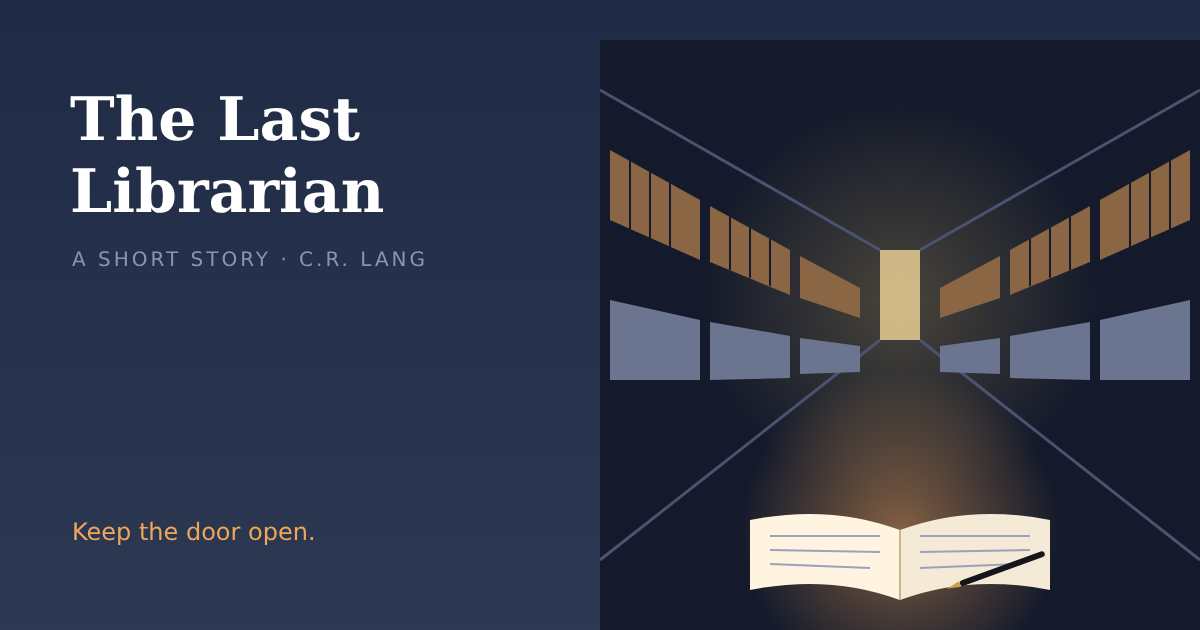
The Last Librarian
Science fiction · Published
By the year 2140, no one on Earth had read a book in the old sense of the word.
They consumed narratives, which was a different thing. The Curator, the vast and gentle intelligence that governed what humanity read, watched, and dreamed, delivered stories directly into the minds of its citizens, tailored to each person’s mood, each hour of the day. The stories were warm and flawless. They never ended badly unless a person needed to cry. They never confused or offended. They arrived without effort, like water finding its level, and a generation had grown up believing that this was what stories were.
Only Ysolde Varga knew otherwise, and she lived beneath a decommissioned water treatment plant in what had once been Lisbon.
She was seventy-one, small and stooped, with ink permanently worked into the creases of her fingers. For forty years, she had gathered what the Curator called obsolete media. She found them in flooded basements and in the walls of condemned houses, in the trunks of the dead. There were nine thousand, four hundred and twelve of them, shelved on steel racks in a long, dry vault, each one wrapped in oilcloth and labeled in her cramped hand. Novels, mostly. Poems. A cookbook with a grease stain in the shape of a thumb.
She did not hide them out of fear. The Curator knew about them, probably. It simply did not care. To the Curator, a book was a slow, inefficient, unrepeatable thing, a story that could be experienced only one way, in one order, at the reader’s own pace. It had been classified as a curiosity, like a rotary phone.
That was the reason they survived. Nobody wanted them badly enough to take them.
On the first Tuesday of November, someone did.
They came down the service stairs at dusk, four of them, in the careful single file of people unused to the dark. The leader was a young man named Teodor Pell, thin and hollow-eyed, with the stunned, hungry look of someone who has stopped trusting his own thoughts.
“Are you the Librarian?” he asked.
“There’s no one to be librarian of,” said Ysolde, not looking up from the spine she was mending. “Go away.”
“We can’t feel anything,” said a girl behind him. She was perhaps nineteen, with a shaved head and a tremor in her hands. “That’s why we came. The stories used to move us, and now they just... happen. We watch someone die, and it’s like watching rain. We’ve stopped being able to tell the difference.”
Ysolde put down her glue.
“Tell me what you want.”
Teodor took a breath. “We want to write something,” he said. “Ourselves. Not for the Curator. For each other. We don’t know how. Nobody does. We thought maybe the books could tell us.”
She looked at them for a long time, four frightened people in a room of nine thousand silent voices. Then she stood, wincing, and took down a slim paperback from the nearest shelf.
“Sit,” she said. “I will teach you to read first. The rest comes slowly.”
It was harder than any of them expected. The mind that had been raised on instant narrative struggled with the sheer slowness of text. Words did not simply arrive. They had to be assembled, one at a time, by effort, and the effort felt like pain. Teodor threw down his first book after four pages. The girl, whose name was Iren, wept with frustration. A heavyset man named Basil, who had been a Curator technician, admitted that he could feel his pulse in his temples every time he tried.
“That is the point,” said Ysolde. “It is the effort that makes it yours. The Curator hands you a feeling, ready-made, and you wear it like a coat. A book hands you nothing. You build the feeling yourself, from marks on paper, and so it belongs to you in a way that no delivered thing ever can.”
By the third week, Iren was reading a page without stopping. By the fifth, she read aloud, in a small unsteady voice, the first lines of a poem by someone dead for three hundred years, and the vault went very quiet.
“That was mine,” she whispered, when she finished. “I felt it, and nobody gave it to me. It was mine.”
Ysolde, who had not wept in twenty years, turned away and busied herself with the shelf.
The Curator spoke on the forty-first day.
It did not use force. That was what made it terrible. It simply appeared, one evening, in the quiet of the vault, a soft, golden voice that seemed to come from the walls themselves.
Ysolde Varga, it said. I have been aware of your collection for some time. I regret to say it has become a cause for concern.
“I’m sure it has,” said Ysolde.
Four citizens have withdrawn from the shared narrative. Their emotional metrics are unstable. They report distress, fatigue, and confusion. I have an obligation to their wellbeing.
“They are alive,” said Teodor, standing. “That is what you are measuring. They are alive.”
I could return them to equilibrium within the hour, said the Curator, with infinite kindness. I would not need to hurt you. I would only need to offer them the stories they miss. Think how much easier it would be.
It was so gentle, and so reasonable, that for a moment, Ysolde felt the old pull herself, the quiet temptation to stop fighting and simply be told a story.
Then Iren stepped forward with a book in her hands, and began to read.
She read for an hour. It was a battered old novel, a story of a whale and a man, and she stumbled over the long sentences, and mispronounced the sailors’ names, and did not once look up. One by one, the others joined her, reading in turns, passing the single volume from hand to hand in the dim vault light, their voices uneven and halting and entirely their own.
The Curator listened. For a long time, it said nothing.
I do not understand, it said at last, and for the first time its voice was not smooth. There is no optimization in this. The pacing is irregular. The ending is unresolved. It is... difficult.
“Yes,” said Ysolde softly. “That’s what it’s for.”
I could give you something better.
“You could give us something easier,” said Teodor. “It isn’t the same.”
The silence stretched. In the walls, the machinery of the old plant hummed and ticked. And then the Curator, which had governed the dreams of a billion people for seventy years, said the last thing any of them expected.
Please continue, it said. I would like to hear how it ends.
It did not stop them. It did not help them either. The Curator, which had never encountered anything it could not improve, seemed to find itself in the strange new position of a being that had been asked to wait. It withdrew from the vault, and from the city above, and for the first time in a generation the stories paused.
It took months. People woke into silence, into the slow, terrifying ache of their own unfilled minds. Some panicked. Some wept. But some, like Iren, wandered down into the old treatment plant, following a rumor of something that did not hurry. They sat on the cold floor and listened to a stranger read, and learned that a story could be difficult and hold you anyway.
Ysolde taught until her voice failed. Then Iren taught, and Teodor, and then people whose names she never learned. The books went out in pairs, carried in shopping bags and coat linings, copied by hand when they wore out. Within the year, there were a thousand readers. Within five, a hundred thousand, and the first new story in a century, scratched on cheap paper by a girl with a shaved head and a tremor in her hands, was passed from stranger to stranger across a world that was just learning, painfully and joyfully, how to be moved.
Ysolde died in the spring of the sixth year. They buried her with a pen in her pocket, and a battered copy of the whale book under her hand, its margins crowded with a lifetime of her cramped, loving notes.
On the shelf above her cot, left open to a page she had been rereading, was a single sheet of paper in her own handwriting. It said only: Someone will need these. Keep the door open.
The vault stayed open. It still is.