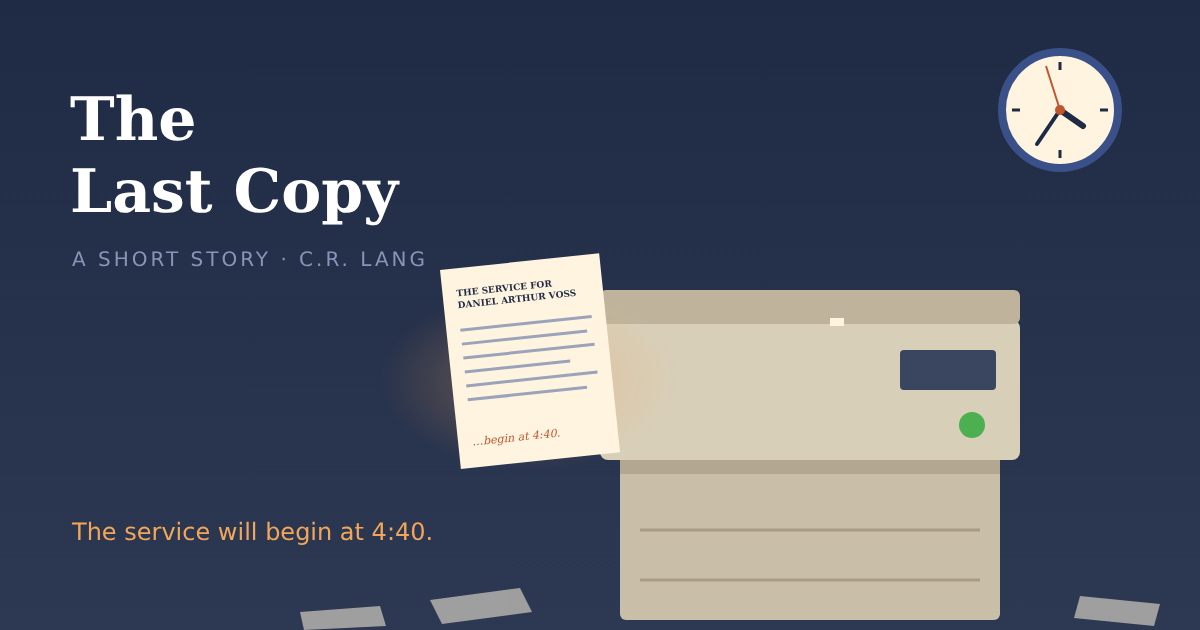
The Last Copy
Horror · Published
The photocopier arrived with the office, a gray beige slab of a machine that had come with the lease and that Daniel Voss had never once thought about. He ran a small accounting practice on the second floor of a building that smelled of radiator dust, and the copier sat in the corner by the window, humming faintly to itself even when it was off.
On a Tuesday in late October, he placed a client’s tax return on the glass, pressed the green button, and watched the light drag its slow bar beneath the lid.
The page that came out was warm, the way they always were. But it was not the tax return.
It was a single sheet, typed in a plain serif font, and it began mid-sentence:
...and the coffee at Mara’s kitchen table was too hot, so he held the cup without drinking it, and for the first time in years he said it out loud: that he was sorry about the house in Wellfleet. She didn’t answer. She only reached across and put her hand over his, and the clock above the stove said 4:40, and outside the window the first snow was falling on the Hendersons’ roof.
Daniel read it twice. He had no sister named Mara. He had never owned a house in Wellfleet. The Hendersons were nobody he had heard of.
He fed the sheet back through the machine, and the machine returned it unchanged, the toner still bright. He crumpled it and dropped it in the wastebasket, and told himself some client had left a short story in the tray. People did strange things with paper.
The next page came two days later. This time he had put nothing on the glass at all.
He was fifty-one when the diagnosis came, and he drove home without the radio. He remembered, years afterward, that the sky that day had been an unremarkable gray, and that he had stopped at a red light and watched a boy in a yellow raincoat jump deliberately into every puddle on the block. He had thought: I should have done that more.
Daniel was forty-eight.
He kept that one. He kept the next one too, and the one after, flattening each against his desk with the side of his hand. They came at odd hours, never when he was watching, a single warm sheet waiting in the output tray when he returned from lunch. They were always about him. A man named Daniel. A wedding he did not remember attending, in a church he had never entered, to a woman whose face the prose carefully avoided. A daughter, who in a later page was nineteen and furious at him over something unspecified. A hospital corridor with a flickering light, and a nurse who stopped talking when he came around the corner.
He began to arrange them on the floor of his apartment in the order he guessed they belonged. The pages did not carry dates, but they did have a rhythm, a kind of sorrowful momentum, and by the second week he could feel the shape of the thing in the way you can feel a staircase in the dark.
The shape went down.
He tried to stop it. He unplugged the machine, and it hummed. He emptied its toner and carried the cartridge out to the dumpster in the alley, and the next morning there was a page in the tray, printed in a black so deep it looked wet. He called a repair service, and the technician spent forty minutes inside the casing and came out shaking his head. “There’s nothing wrong with it,” he said. “Nothing’s in it. No drum, no feed assembly. It’s just a box.”
He did not stay to be paid.
That night Daniel slept in his office, curled on the carpet three feet from the machine, because he could not stand the thought of it printing while he was not there to read. At 3:00 a.m. he woke to the sound of the paper tray sliding, and he crawled to it on his hands and knees like a man approaching an altar.
The page was longer than the others. It was headed, in capital letters, with a line he read once and could not stop reading:
THE SERVICE FOR DANIEL ARTHUR VOSS
The church was colder than anyone expected. About thirty people came, fewer than the hospital staff had predicted. His daughter sat in the front row and did not cry, which people mistook for strength. She was thinking about the last conversation they had, in which he had been distracted and had said he would call her back.
He had meant to. That was the part she could not forgive. He had meant to, for eleven days, and then there were no more days.
The man who delivered the eulogy was a stranger. He said Daniel had been quiet, and careful, and kind in the small ways nobody keeps a record of. He said Daniel had always been about to start living. Several people nodded.
After, in the parking lot, in the first real snow of the year, the daughter found an envelope tucked beneath her windshield wiper. Inside was a single sheet of paper, warm to the touch, though it had been outside all afternoon. It was a photocopy. Of what, she could not tell. Only that it had been made, with great care, of a face.
Daniel read the last paragraph three times. He understood it the way you understand a door closing: without words, in the body.
He did not have a daughter.
But he looked at the date in the corner of his desk calendar. He looked at the phone on the desk, which he had been ignoring since last month, when a woman he used to know had left a voicemail he had never played. He thought about the wedding, and the church, and the face the prose would not describe.
He thought: What if these are not memories of what happens to me? What if they are instructions?
He copied the final page.
He did it without thinking, a reflex, laying the sheet on the glass and pressing the green button, wanting only a second copy to hide in a drawer. The light dragged its slow bar beneath the lid. The machine hummed. And the sheet that came out, warm in his hands, was not the funeral.
It was a blank page, except for one line at the very top, in a font he recognized as his own handwriting.
Thank you. This is the last copy I needed.
Daniel stared at it. He looked at the original, still on the glass, and saw that it had gone pale, the typed words draining out of it like ink into water, until it too was blank.
The machine stopped humming.
In the silence that followed, he heard, from the hall outside his office, the soft dry shuffle of paper sliding across a floor. Then another, and another. They came from under the doors of every office in the building, a dozen, then a hundred, pale sheets whispering toward him along the carpet like leaves before a storm. He backed against the desk. The nearest one slid to a stop against his shoe.
He did not want to read it. He read it anyway.
He thought for a moment that he could stop it. But the copier had only ever copied what already was.
At the bottom of the page, in the same warm serif type, was a single line more.
The service will begin at 4:40.
Above the door, the clock said 4:38.